

How To Clean Ac Coils In Air Handler
 Air Workout Cooling Gyre or Evaporator Coil Cleaning Methods
- Mail service a QUESTION or COMMENT about cleaning methods for air conditioner or heat pump cooling and condensing coils
InspectAPedia tolerates no conflicts of interest. We accept no human relationship with advertisers, products, or services discussed at this website.
Air conditioner or heat pump cooling ringlet / evaporator whorl cleaning methods:
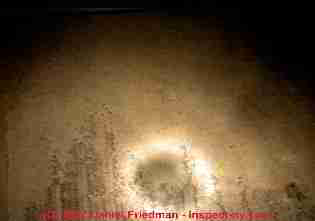
This article discusses the how the cooling curl (evaporator coil) in the ac air handler unit is cleaned. These same methods volition work on the outdoor coil or condensing coil as well. Our photo at page top shows a very dirty cooling coil in the cranium air handler component of a central air conditioning system.
How to clean a dirty or moldy air conditioning cooling curlicue or evaporator curl, or a dirty condensing coil; Use of spray foam cleaners & deodorizers on cooling coils - Use of liquid cleaners on cooling coils; Use of compressed air to clean cooling or condensing coils; Use of pressure washers or steam to clean HVAC Coils.
We also provide an ARTICLE INDEX for this topic, or you can try the page acme or bottom SEARCH BOX as a quick manner to find information you need.
How & Why Ac & Rut Pump Evaporator Coils (Cooling coils) are Cleaned
Which Cooling or Estrus Pump "Coil" is Which: Condensing Coil & Cooling/Evaporator Coils Defined
The COOLING COIL or EVAPORATOR COIL discussed here is the evaporator coil found inside the air handler, used to cool air diddled across it and into the building occupied space. If your business organisation is with If your equipment is a heat pump these terms tin exist a bit confusing considering in heating mode, your heat pump system's indoor coil is warming, not cooling the air blown across it
The CONDENSING COIL is normally on the outdoor or compressor portion of your ac system. The job of the condensing coil is to cool high temperature refrigerant gas to condense it dorsum to a liquid refrigerant form.
Why do nosotros clean the HVAC evaporator or cooling gyre, or the condenser ringlet?
Dirt and debris accumulating on an air conditioner or heat pump coil cake airflow across the coil, increasing the toll of heating or cooling the building. In severe cases cooling or condensing coils can become so blocked that air flow is seriously reduced, possibly likewise leading to an evaporator or cooling whorl icing problem indoors or an overheated, damaged compressor outdoors, or but loss of cooling chapters of the system.
In add-on, a blocked evaporator scroll can cause the HVAC compressor to run at higher than normal temperatures - a status that over time can break down lubricants circulating inside the organization, thus shortening the life of the compressor motor itself.
BLOCKED COOLING COIL - Air Conditioner Evaporator Coil Blocked by Droppings
Water ice on the COOLING COIL is not the only (nor fifty-fifty the virtually common) crusade of blocked air flow in an air conditioner. This photo shows how easily debris can stick to and clog the inlet side of the cooling coil in an air conditioning system. This evaporator gyre was about totally blocked with dust and droppings. How does this happen?
There was no air filter installed in the system. Ordinary business firm dust is comprised largely of fabric fibers and skin cells.
These and other debris in building dust such as soot and organic particles like pollen and mold spores all join to course a gray mat on the fins of the cooling curlicue in an air handler.
Debris sticks particularly quickly to this surface because of the combination of close spacing of the cooling fins (nigh i/16" apart) and the fact that condensate forming on the coil keeps the surface damp.
Details nearly the detection and cleaning of clay and debris which cake an air conditioner cooling coil are at DIRTY COOLING Roll / EVAPORATOR COIL.
Guide to Procedures for Cleaning Air Conditioner or Heat Pump Evaporator Coils: Using Air, Brushes, Chemicals, or Detergents to Clean A/C Coils
Thorough cooling coil or A/C evaporator coil cleaning can crave cutting refrigerant lines, removal of the gyre and other components for cleaning, and reinstallation, pulling a vacuum on the refrigerant lines, and recharge with refrigerant.
Such service and repair may involve meaning expense. For this reason there are several "in place" cleaning methods using foams and sprays that are a simpler procedure for cleaning an air conditioning or heat pump scroll.
Watch out: be sure that electrical power is off to the HVAC equipment before opening admission panels or working on the system. Relying merely on the door safety interlock switch to plough off equipment ability may be unsafe as wiring inside the unit of measurement will still be "live" in some locations.
Using Air: Compressed air for cleaning HVAC evaporator coils
Some HVAC technicians clean an evaporator gyre by blowing it off with compressed air. This is a quick and probably effective method to clean the curl, which has the boosted feature of bravado dust, debris, and peradventure mold into the building air - not something we approve.
Air is sprayed from the cleaner side of the coil towards the dirty side - or in other words, in the opposite direction from the normal air menstruum across the scroll. Be certain to spray from the correct side of the ringlet or yous'll merely exist forcing dirt and debris more securely into the curl fins.
Watch out: if you are using loftier pressure air to try to clean a coil, be sure you blow air at right-angles or straight through the ringlet fins. Bravado high pressure level air (or h2o or steam) at the HVAC coil fins on an angle is probable to bend over the fins, bottleneck the scroll and perhaps ruining it. If just a few fins accept been bent on a curl they tin often be straightened by working gently with an HVAC roll comb designed for that purpose.
Watch out: if you are non careful, just using compressed air to blow off a coil may get out a large amount of grit and debris inside the air handler where it collects anew on curlicue surfaces, or in your eyes (dangerous). Using a shop vac in concert with the compressed air sprayer and moving carefully (to avoid damaging coil fins) can reduce dust and debris spillover and brand cleaning up easier.
Condenser curl cleaning: Nosotros don't have a complaint about using compressed air to clean an outdoor evaporator whorl since we don't take the same concern about bravado debris into the edifice or its duct work.
Brush-cleaning of A/C or heat pump cooling or heating coils
When the curlicue is soiled by a adequately light coating of dust and debris, information technology can often be successfully cleaned using a soft brush. If you clean y'all A/C or heat pump curlicue every three or iv months using this method you may reduce cooling (or heating) costs and you lot may be able to avoid more plush or troublesome coil cleaning procedures.
If your HVAC equipment is operating in a dusty surface area or if no one has been maintaining proper filters in the system information technology is probable that you'll need to clean the coil more frequently, mayhap even monthly to go along the A/C or heat pump organization at peak operating efficiency and effectiveness.
We have tried using a shop vac with a soft brush attachment to clean the A/C coils, simply if your curl is mounted in the air handler so as to not leave much room to access all of its surface this approach doesn't work well.
Watch out to avert damaging curl fins when using whatever tools, brushes, or vacuum cleaners around the equipment.
Using Chemicals to Clean A/C Coils
There are plenty of coil cleaning chemicals sold for cleaning A/C or heat pump systems, both acid and alkaline-based.
Watch out: We practise not recommend using strong chemicals on an A/C or heat pump roll because of the chance of corrosion damage to the coil or the production of noxious odors & fumes. To be safe, cheque with your HVAC equipment manufacturer to exist sure that your cleaning arroyo is one they corroborate.
Indeed in that location are foaming cooling whorl cleaners on the market that can gently lift and help remove scroll-bottleneck debris with minimum damage to the cooling coil.
Field Study: corrosion visible afterwards a cooling coil was cleaned
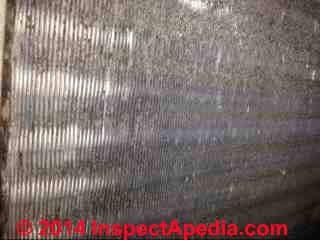 I simply had my duct piece of work and AC cooling fins cleaned out. After the cleaning information technology appeared as if the aluminum cooling fins were full of with fluffy green stuff.
[Click to enlarge whatever image]
I chosen the technicians who came back to look then explained that what I was seeing was corroded aluminum that was more visible since the cooing fins are at present clean. Although this sounds plausible I take two concerns.
ane. if if is corroded aluminum do I demand to be concerned near using the ducts.
OR
2. it is not corroded aluminum and they did a really bad chore at cleaning
The cleaners are part of the national duct cleaners association (NADCA), seemed quite knowledgeable and experienced (no complaints, A+ at BBB), but I am surprised that the fins look and then bad. I would like to know whether what I am seeing is to be expected.
l. I did snap a moving picture on the one side of the "V" that was easily accessible, here it is. This is the Afterward cleaning picture show, I dont have a earlier. The schmutz has a slightly greenish hue.
The AC handler and ductwork is old, and based on the amount of crud throughout the organisation appeared as if it may have never been cleaned before.(the condenser unit itself is 25+ years old, just still working). That determination also comes from the fact that the prior owners seemed to accept pride in performing NO bones maintenance on the house for many years. I just hope that firing upwards the Air-conditioning system in a couple weeks won't endanger my family. - Kevin iv/28/2014
thanks. K.C. 4/28/2014
Reply:
In my initial respond I said "I am not sure I buy the explanation that "you lot only see the crud because now we've cleaned the coils". That would be the instance if nosotros saw thick green crud that was really blocking or covering-over the coil assembly.
Just now that I can do good from seeing your photo (above left) I think that nosotros are looking at corroded aluminum fins on the coil and that the cleaning company is existence dead honest in saying you couldn't see this before - this condition would have been covered if in that location were a layer of thick grit and debris.
Your photo is not quite articulate on the point, simply if in that location is good air menstruum between the fins on the whorl and presuming it'due south not leaking, it should exist functional. This is about as good equally y'all're going to get in cleaning this coil. It would non be probable that the coil cleaning procedure using approved methods and materials would endanger your family unit. (Y'all might nevertheless want to inspect the HVAC arrangement ductwork for cleanliness, including the air handler and blower fan associates.)
At that place is some heat transfer loss where aluminum roll fins are deteriorated by corrosion, simply nearly likely a significant gain in coil operation overall past cleaning if it was previously debris-clogged.
To empathize this curl'due south performance better, an in-focus photo looking straight into the curlicue fins - at right angles to the plane of the coil - would let u.s.a. meet whether or not there is open air infinite between the fins. Accept care not to damage the fins nor cut yourself on sharp edges. It may help to endeavour shining a light from the other side of the coil if it's accessible. If non the photo will rely on lighting or a flash from the camera'southward side.
If nosotros see open air space between the fins then the coli has been successfully as opened as we're going to become information technology.
Unfortunately I cannot recommend any more ambitious cleaning like brushing. The aluminum fin textile is thin to begin with and is more than fragile now as it has been corroded. More aggressive cleaning that bends (which ways blocks) or removes (which means nevertheless more than chapters loss) fin textile just makes matters worse.
Replace the coil, or the whole unit, if/when the coil leaks refrigerant.
Field Report: Using Hydrogen Peroxide to Clean an HVAC Coil?
I used Hydrogen peroxide iii% to do the task and it gave a bad smell. Kind of a chemical smell. I think the peroxide reacted with the zinc,aluminum, copper or nickel metallic in the cooling coils. Is it OK to utilise peroxide to make clean cooling coils too the conventional HVAC tech cleaning methods? I live in an apartment and sometimes my AC air starts to get a moldy smell to information technology.
The first time I cleaned it out myself in that location was all this orangish yucky fungal sludge in the drip tray and there was so much of it that it had clogged the bleed pipage which I had to clear out. I cleaned it out with 5% hydrogen peroxide and whatever information technology was it bubbled like crazy so I believe the peroxide was reacting with a biological agent. It also reacted with something betwixt the fins of the cooling gyre to give a smell slight of sulphur and burned gunpowder. What are your thoughts on the matter? - N.Yard.
While we accept read reports that the oxide on the surface of aluminum HVAC coil parts reduces the severity of chemical reaction between an acid or base cleaner and the metallic, we accept likewise had reports of problems with corrosion and odors when this arroyo was tried.
So while the "bubbles" action of hydrogen peroxide is appealing as a cleaner, we are warned that chemical reactions between some coil cleaning products and the aluminum or copper A/C or heat pump scroll parts can corrode the fins or tubing, damaging the system, ultimately leading to leaks and the demand for a costly coil replacement.
Chemic reactions betwixt some curl cleaning products and the aluminum or copper A/C or oestrus pump coil parts can also produce obnoxious odors or fumes, possibly toxic or irritating fumes, and in some cases may exit an olfactory property in the system that itself becomes an consequence.
Run across our discussion of detergents and foam sprays for coil cleaning, below - those are safer approaches to coil cleaning, specially if you're not an adept.
Using Detergents or Water for cleaning A/C coils
Using a simple mitt sprayer or garden sprayer (these produce a gentle spray) it may exist possible to clean your A/C or oestrus pump coil effectively using tap water or a mild detergent. The advantage of using these gentle solutions is that at that place is trivial adventure of damaging the coil fins or tubing compared with the use of more harsh chemicals.
Wet the A/C or heat pump coil surfaces with your spray-on detergent, allow it soak in for 15 minutes or so (but non long enough to dry out out), then rinse the coil and scroll fins make clean. Remove spillover and droppings from the condensate pan where your spray and droppings land, using a shop vac or hand wiping.
Scout out: don't bang around inside the air handler with your shop vac or you may harm the evaporator/cooling whorl or coil fins; and exist careful when wiping by hand that you don't get cut on sharp fin edges.
If using water or a not-sudsing mild detergent doesn't piece of work to clean off your curlicue, yous may need to use a more aggressive coil cleaning method such as those described below.
Using Foam or spray HVAC coil and fin cleaners
Using a garden sprayer (or a sprayer that may exist included in some pre-packaged A/C coil cleaning systems and products), the coils are sprayed with a foaming cleaner specifically designed for HVAC systems. An reward of this approach is that it is mechanically gentle, reducing the take a chance of harm to the coil or its fins. And if you lot select a beneficial cleaner it is besides chemically gentle, avoiding corrosion damage to the coil.
Where to Purchase HVAC and Refrigeration Equipment Curl Cleaning Products
Advice on Choosing an A/C or Heat Pump Curlicue Cleaning Production: chemistry
Watch out: review your selection of HVAC coil cleaner with the equipment manufacturer and/or the cleaner manufacturer earlier choosing a coil cleaner, and and so be sure to follow the roll cleaner'southward instructions. Choosing the wrong type or wrong chemistry of gyre cleaner or failure to rinse off cleaners (some require rinsing) can result in costly damage to the coil and could even be unsafe.
Do not use an acidic soil cleaner on coils fabricated of aluminum, copper, or other metallic that may be damaged by the corrosive furnishings of the copper. Some air handlers use a plastic blower squirrel muzzle fan wheel that is also sensitive to acids, condign breakable and possibly breaking from acid treatment.
Some HVAC service companies may employ an acidic curlicue cleaner on the outdoor coil, followed by a h2o wash.
Some HVAC service technicians whose comments nosotros've read or asked-for opine that plain water is perfectly adequate to clean and rinse most residential outdoor coils.
When to Employ a Cocky-Rinsing Coil Cleaner
Some but not all scroll cleaning sprays and foams require rinsing of the ringlet after use. Typically the outdoor coil in the compressor/condenser unit of measurement volition apply a coil cleaner that is followed past a rinsing step since rinsing the outdoor equipment can be practical.
Indoor coils in an air handler are commonly selected from products that don't require a rinse step since rinsing with a garden hose (for example) would be impractical indoors. Cleaners that do not require an boosted rinse step are typically described on their label or in their instructions every bit "cocky rinsing", typically using a slightly alkali metal detergent cleanser.
How does a self-rinsing scroll cleaner work? Residues from the whorl cleaner are washed off of the coil fins and tubing by condensate that forms on those surfaces when the indoor unit is run in cooling mode.
That rinsing condensate is and so collected in the coil condensate drip pan, routed from in that location to an approved condensate bleed, or perhaps through a condensate pump to the bleed. (CONDENSATE Treatment, HVAC has details)
Practise not Make Your Own Roll Cleaner
Do not try making your own gyre cleanser out of other household cleaners like bleach, dishwasher or laundry detergent, equally these may be harmful to the curlicue metal fins or even its tubing.
Do not use a roll cleaner containing trichloroethylene inside buildings (such as schools or post offices) where use of those products is prohibited.
Watch out: nosotros do not recommend use of high pressure level cleaning on cooling or condensing coils. High force per unit area tin damage delicate scroll fins and can fifty-fifty accident off or damage sensors or electrical connectors.
List of HVAC curlicue cleaning chemicals, foams, and sprays:
- AC-Condom Scroll Cleaner, Nationwide Products, AC-921 Cream Curlicue Cleaner
SDS for AC-Prophylactic Curlicue Cleaner [PDF] retrieved from Home Depot Stored 2017/10/23
- C-Shine is a mix of chemicals produced in Republic of india and intended to remove dirt, grease, and debris from A/C coils in a procedure the manufacturer, ICC, describes as "chemic de-scaling" or (misspelled at their website) chemical de-scaling
- CoilShine is described by Goodway as "a [non-acidic blend of powerful, fast acting detergents, specifically formulated for use with the CC-140 CoilPro power washer] biodegradable, expanding foam detergent specifically formulated for apply with the CoilPro.
This is a non-acidic, non-fuming solution that can be safely done down drains. CoilShine-BC is a commercial grade, set-to-use mold inhibitor for HVAC systems that helps foreclose the growth of smell, stain and impairment causing organisms such as mold, mildew and fungi."
- Com Koil External Condenser Coil & Brightener (Acidic), from ComStar, ComStar International Inc. xx-45 128th Street, College Point, NY 11356 Us Tel: 718-445-7900 800-328-0142 described by the manufacturer as ok for aluminum and contumely, rinsed with h2o
ComKoil SDS [PDF] contains hydrofluoric acid, phosphoric acid, surfactant, and water.
- ComStar 90-184 Foaming Coil Cleaner (non-acidic), for both evaporator and condensing coils,
- Nova-Tech International sells a dry powder used to brand an alkali metal HVAC coil cleaning liquid that can exist sprayed onto the curl.
- Nu-Calgon Cal-Brite A/C Condenser & Evaporator Roll Cleaner, a liquid, sold in concentrated course, used to remove lint, dust, grime, oxide deposits, cottonwood, bugs, grease, dirt, oil from a cooling or evaporation curlicue in HVAC equipment.
Nu-Calgon, 2008 Altom Court St. Louis, MO 63146 (800) 554-5449 Website: http://www.nucalgon.com/
Contains ammonium bifluoride and glycolic acid. See this
Cal-Brite Nu-Calgon MSDS [PDF], retrieved 2017/10/23, original source: http://world wide web.nucalgon.com/assets/MSDS/English/4133.pdf
Nu-Calgon Cal-Brite Coil Cleaner SDS Rubber Information Canvas, retrieved 2017/10/23, original source: http://www.nucalgon.com/avails/SDS/English/4133_SDS_ENG.pdf
- Nu-Calgon Nu-Brite A/C Condenser Coil Cleaner, concentrated, water-based with degreaser, this is a foaming cleanser diluted with water 4:1
- Nu-Calgon, Evap-Fresh Coil Cleaner, no rinsing required, Evaporator Cleaner, Liquid, for Evaporator Coils in Modest Air Conditioners, HVAC Cooling Coils and Refrigeration Equipment, Cleaning and Disinfecting, Not-Abrasive
- SpeedyFoam Condenser Roll Cleaner (non-acidic, biodegradable, alkaline, foaming cleaner), Tel: 888-700-3540 https://www.speedclean.com/ Website Excerpt:
SpeedyFoam is safe for coated and uncoated coils. It is an acid-costless, alkaline, non-caustic, degreasing foaming formula. (Say that 10 times fast, I dare you). It's safer for employees to use, more effective on grease and works dandy on all metals and has a make clean, fresh aroma. Plus it's 4x concentrated, and so you get more than bang for your cadet. It's designed for use with CoilJet and Condenser Needle but tin can exist used with pump sprayers also.
- Superior Industries offers FCC-300™ not-toxic foaming spray coil cleaner and "conditioner".
- Total Gyre Cleaner (Acidic),
- CONTACT us to suggest boosted coil cleaning products
The HVAC roll spray arroyo has the appeal that the total cleaning cost is depression, no rinsing is necessary with some products, and the coil looks overnice.
Where does the debris and run-off cleaner become? It should drip into the condensate pan for disposal through the condensate drain system. The manufacturer says the ringlet and fin cleaner likewise removes odors from the system, but if your HVAC system is quite dirty additional steps volition be needed to clean the blower assembly and the ductwork.
Afterwards the coil cleaning foam has worked on the coil surfaces and dripped to the condensate pan below, utilize a wet-dry shop vac to clean upward the mess from the pan, followed by careful wiping equally we cited above.
Using Pressure Washers to Clean A/C or Estrus Pump Coil Fins & Tubing
Professional HVAC service companies often utilize a portable A/C curlicue pressure washer designed for that purpose. Unlike cleaning detergents or foams, a pressure washer is physically more than aggressive coil cleaning method and is mayhap the nigh thorough or effective method for cleaning a desperately soiled or blocked HVAC evaporator or condenser coil.
A portable pressure washer unit such as Goodway'south CC-140 contains both a whorl cleaning solution (typically a detergent mix) and a battery-operated pressure sprayer that can deliver as much as 140 psi. Heavier-duty curl cleaning pressure sprayers are available for commercial units and larger, or heavier, wider coils.
Watch out: as we warned earlier, if you lot are using high pressure level air, water, or steam to try to clean a whorl, be sure you blow air at right-angles or straight through the coil fins. Bravado high force per unit area air (or h2o or steam) at the HVAC coil fins on an angle is probable to bend over the gyre fins. And don't over-do it and don't spray more cleaner than needed - you'll just have more liquid cleanup to do after the curlicue has been treated.
Using Steam-Cleaning of A/C or Heat Pump Coils
Steam is used past some technicians to clean HVAC coils, in a process similar to that we described to a higher place for compressed air.
Watch out: as we warned before, if y'all are using loftier pressure air, water, or steam to attempt to make clean a coil, exist sure yous accident air at right-angles or straight through the gyre fins. Blowing high pressure air (or water or steam) at the HVAC curl fins on an bending is likely to bend over the coil fins.
If your air conditioning or heat pump system has lost its cooling capacity or won't start see REPAIR GUIDE for AIR CONDITIONERS. Come across COOLING CAPACITY, RATED of air-conditioning equipment if the system seems to be working but is inadequate to cool your building.
Reader Comments & Q&A
Without a product proper noun nosotros can merely gauge that information technology was perhaps a h2o-activated foaming cleaning and disinfecting amanuensis. It'south not the greatest treatment but information technology might aid.
I paid $threescore for my HVAC guy to sprinkle some kind of powder over the coils of the air handler which he said the condensation running downwards would make clean the pan and the pvc drainage pipage... what was that?
Unless you missed something, information technology sounds equally if you're correct, the installer didn't provide a cleaning access. Typically the cleaning tech has to cut an opening and fabricate a sealable panel for futurity cleaning.
I've seen and read several pages on how to clean the Air-conditioning evaporator attached to a central air furnace. All the info shows removing a panel/side off the box around the evaporator, then usually removing a shield/wall of the side of the evaporator itself to access the fins etc. However on mine, there are no removable walls/panels on the box to get at the evaporator, it looks custom built out of ducting box stuff and not made to come apart at all.
At that place is only a unmarried pocket-size access hatch (8x8") to admission some plumbing and yous tin can also run into the serial # and model of the evaporator. What'due south the bargain, did they actually build information technology (before I bought the business firm) and not exit access to the Air-conditioning?
Only existent options I tin think is somehow cutting a much larger access panel, only there are pipes and hoses running around in in that location and I could hands cutting something. Any communication?
HannahI can't tell what we're looking at - in the photo that is.
The red areas look blurry but perhaps like rust.
Hello, Had a very hay wire A/C trouble which had bacteria spewing from each vent in ceilings causing astringent sickness just-that'due south a whole other question. After a supposed "inspection" I took the filter off and establish this stuff from where standing water had pooled.. apparently non cleaned, can this produce fifty-fifty more than harmful toxins to circulate? Is this bad especially if "professionally" checked?
Thank You lot!
Image LOST by older version of Comments code - now stock-still. Please re-mail service the epitome if you can. Distressing. Modern.
Imran
If you apply the search box simply higher up to find our article on
HVAC AIR Menstruum IMPROVEMENT
, you volition see a checklist of things that yous should examine in diagnosing the trouble that you accept described.
please help me i have split air-conditioning install at my home indoor & out unit of measurement. yesterday i cleand my indoor unit because of durty subsequently cleaning i install if agane now the ac cooling is ver low air is non very cool like earlier clean outdoor unit gas prasher is ok compressor ok condenser is ok every think ok just cooling not good room temp
delight assistance me i have dissever ac install at my domicile indoor & out unit of measurement. yesterday i cleand my indoor unit because of durty after cleaning i install if agane at present the air-conditioning cooling is ver depression air is non very absurd similar before clean outdoor unit gas prasher is ok compressor ok condensor is ok every think ok only cooling non good room temp maximum 27-26 instant of 20 . could any one help me please
The "deodorizer" isn't the important step and in fact can be a "bandaid" approach.
What'south of import is that the cooling coil be actually cleaned - IF NEEDED - that is, if it'southward blocked by dust, dirt, droppings. Typically companies who practise this cleaning with the scroll in place past vacuuming and using a foaming cleaner that's defenseless on a tray below. A deodorant spray isn't a substitute for cleaning. Vinegar is a mild household cleaner that has widespread use and has been used in HVAC systems.
I hold with Fugler (2004) that HVAC equipment must be actually cleaned earlier people can apply biocides, sanitizers, etc. The cleaning is the more-important step.
- McNeice, Russell. "Method of Increasing Efficiency and Reducing Thermal Loads in HVAC Systems." U.S. Patent Application xiv/149,631, filed January seven, 2014.
- Fugler, Donald W. "Duct Cleaning: Exercise Homes Demand Information technology?." ASHRAE periodical 46, no. 6 (2004): 28.
I am very chemically sensitive. I am going to take a yearly ac check soon. My ac is almost one year old. Can a spray bottle of vinegar/week (how much) exist used to clean the coils. The visitor I apply , uses deodorizer which I cannot have washed. thanks.
ekhtsasy said:
Yearly Ac Maintenance Matters
There has been some question from my customers in the past few months virtually heating and air conditioning Cleanings and their importance to the proper operation of the equipment. I wanted to write this article to discuss a few important issues that can occur in absence of the annual maintenance.
There are two important cleanings that need to be performed by a qualified heating and air workout company to ensure condom and proper system operation. For the sake of this article we will dissever the cleanings into two separate articles (furnace cleaning and air-conditioning cleaning) and but discuss i at a time.
Air-conditioning Clean and Check
After an entire winter of being dormant and non in utilise, an air conditioning arrangement has a big task at task upon first starting up for the summer. The way an air conditioning condensing unit (outside unit of measurement) works is by changing the state of the refrigerant in the system from a liquid to a gas. This generates a heat transfer and cools the air through a curl within your home. So after seven months of not beingness used the component that compresses the refrigerant back to a liquid has not been used and lubricated through the refrigerant
Thanks so much Melani; we work hard to provide useful information and are thrilled when it works for our readers - and for yous.
Daniel
I just wanted to say thanks and so much! My firm has gone from 91 degrees within to 78 and dropping rapidly thanks to your how-to articles. It is e'er very satisfying equally a adult female to be able to say "Yep, I fixed that," and you made it possible. And while saving me a ton of money. Y'all've made me and my family unit super happy and much cooler on this hot Texas night.
Question: is acid cleaning the cooling coils necessary?
(Oct 28, 2014) Dennis R. Sullivan said:
Is acid cleaning of coils necessary?
Reply:
No, Dennis, information technology's not necessary and may be risky to use corrosive acids to clean HVAC evaporator coils. There are specific whorl cleaning sprays and products formulated for that purpose. But yes, if a cooling coil or evaporator curlicue is chock-full information technology must be cleaned for the HVAC system to operate.
Question: relationship of blocked cooling coils and the HVAC compressor
(Feb 10, 2015) R Koch said:
Hi. Can it be said with 100% accurateness that a blocked evaporator coil can crusade the compressor to footing? Also, is the evaporator curl normally cleaned with a maintenance plan? Thank yous.
Respond:
R Koch:
"Cause a compressor to ground" - huh? If you lot hateful is the evap coil necessarily electrically grounded, no. You lot sound besides much like a lawyer hoping to sue someone. But I'll respond you anyway.
Virtually annual HVAC maintenance plans, they vary all over the place in my experience. Typically the plan will
- include an annual inspection
- an annual check for proper operation
- repair or replacement of lacking parts included in the "inclusion" list
and vague language such as
"annual maintenance plan covers the diagnosis and repair, replacement or adjustment of the specified parts within your Cooling Unit as deemed necessary by our Authorized Service Technician"
Nothing in the sample plans I reviewed specifically indicated evaporator-cooling coil cleaning.
Question: When cleaning a cooling whorl do you accident air or h2o from within or outside the unit?
Do y'all accident the force per unit area air or pressure h2o from the inside out or from the exterior in on the unit? I sprayed it from the outside in I recollect It may have been the incorrect direction. - Sherry 6/7/xi
Reply:
If you are trying to clean a dirt-clogged A/C coil, the best outcome is achieved if you lot can blow from the clean side and then that you lot are pushing the dirt and debris back off instead of forcing it in betwixt the scroll fins. However sometimes it is and then difficult to access the clean or outlet side of the cooling coil that technicians utilise cleaning foams and water instead. In that example they may spray from the most accessible side.
Ultimately, if you tin meet that the spaces between the curlicue fins is free of clay and droppings, and you lot've cleaned the crud out of the housing, and y'all oasis't soaked and shorted electric components, you've been successful at cleaning the air conditioner coil.
Question: Can chemicals or cleaning products harm a cooling coil in an air conditioner or heat pump?
I recently had some problems with the Air conditioning unit of measurement. At one point the tech cleaned the coils and etc. and I recollect him maxim that he used some kind of coil cleaner. After this was done, I started having a major problem of toxic or exhaust similar fumes coming through the ducts. I had to plough the unit of measurement off because it started burning my optics, skin and pharynx. The techs have checked several times and tin find nothing wrong.
I read above where it says "Chemic reactions betwixt some coil cleaning products and the aluminum or copper A/C or rut pump coil parts can also produce obnoxious odors or fumes, possibly toxic or irritating fumes, and in some cases may exit an scent in the organization that itself becomes an issue". My question is, If this is the trouble, what needs to be washed to go rid of the fumes and clear out my organisation? Any aid is appreciated. Thanks. - M.B. six/20/11
Reply:
MB: there are more than benign foaming cleaning agents that should not corrode or otherwise damage a cooling coil when used according to directions. If your technician has already used a caustic amanuensis (which is what your question indicates) it may be necessary to farther clean the coil and air handler with a non-caustic cleaner to neutralize whatever ongoing corrosion and to stop generating the odors and fumes you described.
If the service technicians are sure that the odors and irritants you depict are not due to the cooling coil cleaning procedure then information technology'south appropriate to perform some farther diagnosis, mayhap by technicians with more experience. That procedure should accost the question "Why did the fumes begin just after the curlicue was cleaned?"
Reader follow-up:
I used vinegar. Information technology has an low acid base of operations, however it produces some results to smell. I also come up back with baking soda to off set any acid. I heard where it was good for drains and so I tried it. I like the garden sprayer thought, may utilise information technology next time. I used a spray bottle this time and it worked fair. I vacuumed with a shop vac and information technology nevertheless was every bit clean equally I wanted merely over time, maybe.
Reply:
Indeed farther coil cleaning with a more gentle cleaner to remove left-over chemicals from the roll cleaning task may aid; take a farther look at the coil fins for impairment.
Question: using Web coil cleaner containing 2-butoxyethanol and diethylene glycol to make clean frozen A/C coils
Is information technology safe to use Web Gyre Cleaner on the Heat Coil (inside)? It contains two-butoxyethanol and diethylene glycol. The rut pump cooling coils are frozen. I already cleaned the condensate drain pipes.
Reply:
Anon, if your whorl(due south) are frosting or frozen, the cleaner is not designed to remove ice; you lot'll need to turn off the system, let the ice melt, audit the coils for dirt and debris or other harm, and clean them if that's the instance. Information technology's odd to have simultaneous icing on both condensing and cooling coils; has anyone checked the refrigerant charge level?
Question: using Elementary Green to clean a cooling coil or evaporator A-roll in an air conditioner
Question: I want to clean my evaporator coil,(A-Scroll) inside the air handler, with Simple Green and tap water. I'm concerned near the water washing down into unit of measurement and damaging the blower motor and electronics. I know there is a narrow baste pan around the base of the coil merely i'thousand agape of the overflow. Are my fears unfounded or.? - Paul - ten/19/11
Reply:
Cleaning with elementary Green or fifty-fifty plain water will risk damage to the blower motor and electronics if y'all go them wet - they are not intended to be immersed nor soaked in liquid. You should be able to go on water and cleaner on the ringlet and fins and in the condensate pan. If y'all exercise so and at that place is little overspray onto the motor just wipe information technology off. If yous can't clean in the air handler without spraying more than water near then y'all'll want to use taped up plastic to protect electrical components from the spraying procedure.
Question: Is using an evaporator coil cleaner regulated past environmental belch regulations?
During a recent audit finding, and regarding our regular and routine coil cleaning, we were told it is a code violation if you belch any pollutant or cause, permit, or let a discharge of whatsoever pollutant from a point source without a permit. I don't think this is true or even applicable to coil cleaning...your input is profoundly appreciated. 10/18/eleven
Answer:
Frank, that's a new one on me. Who divers HVAC coil cleaning as a polluting process? If you used soap and water would that be a pollutant? Typically ringlet cleaners are a foaming agent that is used to assist elevator dirt off of coil fins. The material is h2o soluble. If you give united states of america the name of the coil cleaning product you or your HVAC tech intends to use we can further research this question by taking a look at the MSDS for that cleaner. That ought to put an cease to what sounds similar a bit of an odd question. Finally, I suspect that someone might have been worried that you were going to dump refrigerant into the environs. If that's the example then s/he does not empathize that HVAC curl cleaning is an external cleaning procedure that does not address the interior of the HVAC refrigerant piping arrangement.
Question: how often should you acid-wash the air conditioner coils?
Usually, how often should you acid launder the inside air conditioning coils? Delight don't tell me when they're dirty.... Thanks - Terry v/6/12
Answer:
Terry: well "when the coils are dirty" is nevertheless the correct respond, sort-of.
Really yous desire your service technician to inspect visually for the presence of plenty dust and grime that air passage through (between) the fins has go partly blocked.
Lite dusting on the cooling coils is not worth a launder.
Watch out: And nosotros want to "acid wash" coils as seldom as possible because you are using a corrosive fabric. I'd look into less corrosive cleaning methods.
Question: What'south the best way to clean the A-curl without removing information technology from the air handler?
Would similar to know the best manner to make clean the A-gyre without having to remove it fron the air handler. I want to use a foam spray that does not demand to be rinsed out, are these types of foams o.k. for the coil? - Mark 6/22/12
Reply:
Mark, some of the foaming A/C coil cleaner sprays are intended to clean the curlicue fins, baste into the tray below and exit at the condensate drain, some without rinsing. But I'd picket for sending blobs of crud that, if information technology does not fully dissolve, such as clots of lint and grit, may clog the condensate bleed. If yous can get good view access to the whole assembly you lot can be confident of the result.
Question: Water leaks out of air handler traced to dirty cooling gyre?
thank you for your detail explanation. I had water beneath the coils on the concrete. The Tech said it was coming from the condensate drain line. Information technology wasn't wet ! I cleaned the h2o upwardly and stuck my head inside the handler and the water was dripping from the inlet side of the coils. I read where this condition was from dirty coils. I used your article to clean the coils and merely a few droplet of condensate remain. I'thou going to clean them a 2nd time but I have to rest my dorsum. Thanks for your article that and so comprehensible
Reply:
David cheers so much for the feedback.
It makes sense that reduced airflow through a cooling scroll might in some arrangements reduce the push through of condensate to the coil inner face where it has an easier time dripping into the condensate tray.
Merely if yous tin can, send me a photo of what yous see of the condensate tray below the inlet side of the organization ringlet.
Because the air handler'due south condensate collection tray ought to extend far plenty on all sides of the cooling coil to catch condensate on the forepart or inlet side too.
When there are condensate leaks below or out of an air handler and the condensate drain is not chock-full, it makes sense to also check too for a tipped or leaky condensate pan.
Question: water beneath the coils - tech says condensate drain line
(Aug 5, 2012) david n. simmons said:
thank you for your particular explanation. I had h2o beneath the coils on the physical. The Tech said it was coming from the condensate drain line. It wasn't wet ! I cleaned the water upwards and stuck my caput within the handler and the water was dripping from the inlet side of the coils. I read where this condition was from dirty coils. I used your commodity to clean the coils and just a few droplet of condensate remain. I'm going to clean them a 2nd time simply I have to rest my dorsum. Thanks for your article that so comprehensible
Reply:
David thanks so much for the feedback. Information technology will assist others and I will detect a mode to incorporate your comments in the text. Information technology makes sense that reduced airflow thuu a cooling scroll might in some arrangements reduce the push through of condensate to the coil inner confront where information technology has an easier time dripping into the condensate tray. But if you tin, send me a photograph of what you see of the condensate trau ceneath the inlet side of the organisation curl. Because the tray ought to extend far enoughn to catch condensate there likewise. Check too for a tipped or leaky pan.
Question: dripping sound from the evaporator
(Aug 17, 2012) R.Blackness said:
I noticed last night a louder than normal dripping sound coming from my evaporator. After inspecting, I run across in that location is rust effectually the copper tubing and forth the lesser where the evaporator sits on top of my furnace. The condensation is evacuating from the drip tray properly, but the rust has me concerned. Is at that place a way to forbid any farther corrosion?
Answer:
sounds every bit if a condensate drain is chock-full - leading to pan overflow. Watch out besides for dangerous damage to the furnace heat exchanger.
Fix the clog and / or leaky condensate pan.
Ask your heating service tech to inspect or test the heat exchanger for leaks and safe - avert a carbon monoxide fatality.
Question: tried compressed air to clean the cooling roll - no good. what other coil cleaning options are there for an inacessible curl?
I tried using compressed air but i am non getting very far. Spray is hard to get in from the inlet, almost working bullheaded if i do that. The foam sounds similar a skilful solution for me. Is it ok to apply on the make clean side (outlet) of A-coil? What are my options?
Nick
Chicago
Reply:
Cleaning
Squirting scroll cleaning foam onto the clean side of the cooling coil will probably non be effective. A pro would make an admission opening if necessary, then close and seal it when cleaning is complete.
Question:
(Feb 20, 2013) Keith said:
Tin can alcohol exist a corrosive agent in cleaning heat pump coils? It has been serviced 3 times for "Muddied Sock Syndrome" simply the cleaning amanuensis and antibacterial deodorizer recommended past service agent did non work. If not booze, what other materials would you lot suggest?
Reply:
Keith,
Alcohol would non be likely to damage metal components merely might be a problem for sealants or some plastics or other gaskets.
Question: how to remove corrosion on outside AC coils - caused past domestic dog pee
(Apr 2, 2013) Sherri said:
How to remove corrosion on outsdie ac coils from dog pee? I can see the corrosion on the inside of the unit.I was going to try that foam cleaner form the Home Deopt. IS my unit ruined? the corrsion is just on ii corners and about 5 inches high.
Answer:
Sherri,
Using a commercial curlicue cleaner will remove some corrosion and debris and odors. I would not try using anything also aggressive on corroded HVAC coils out of worry that nosotros dissolve the fins entirely. If the ringlet is badly corroded information technology means that airflow through it and estrus transfer are retarded, decreasing organization efficiency and increasing operating toll. One might consider replacing the coil but the toll is high plenty that as long every bit the AC or Heat pump is working in my OPINION you lot won't earn dorsum that price very chop-chop.
On the other hand if the equipment is old and on last legs, this is time to start thinking about replacing the unit of measurement.
Question: odd heat pump odor when changing from heating to cooling fashion
4/2/14 Bruce l. said:
I take i twelvemonth old heat pump unit and the only trouble is when I go from Heat to a/c the indoor unit gives off a very odd oder. Not when I get from a/c to Oestrus.
Reply:
Bruce let's think about what's different switching from heat to A/C vs A/C to rut. Typically the same blower fan, ductwork, and air registers are involved in both modes. What's different is the direction in which refrigerant is circulating within the organization - not something that would explain an odor divergence. Besides dissimilar is that in cooling fashion you lot're probably producing condensate, perhaps operating a condensate pump. I'd await at that organization to start.
Question: grime on the cooling ringlet, limited work space, volition the tech practice a better job than I can
4/5/14 Darren said:
I have taken off the embrace for the evaporator roll and determined that the supply side is clean but the within of the curlicue has a skilful sheet of crud covering it. I have a very pocket-size space to work and am unable to put something inside the unit of measurement to prevent the grime from falling downwards into the blower. With this business organisation I have contacted an HVAC Co. and have an appt for them to come and clean the unit of measurement in place (not taking it out).
My question to y'all is what if annihilation will the technician do to prevent the crud from falling into the blower. I suppose they could remove the furnace assembly below and and so accept some access for placing a piece of plastic. Before I spend $260 i desire to know that the technician is going to practise something more I could do myself.
Reply:
arren,
Typically they use a foaming cleaner that drips through the curl into a pan. It may be that the blower assembly needs to be removed for proper cleaning. You're expressionless right to inquire for specifics about what they're going to practise. Only usually someone with experience at methods for cleaning difficult-to-access cooling coils knows some tricks of the trade that you may non. Or she/he may simply make and and so re-seal an access opening.
Question: what volition the HVAC tech do to go on scroll cleaning grime from falling into the blower?
(Apr 5, 2014) Darren said:
I take taken off the cover for the evaporator ringlet and adamant that the supply side is clean but the inside of the coil has a good sheet of crud covering it. I take a very small infinite to work and am unable to put something inside the unit to prevent the crud from falling downwards into the blower. With this business I have contacted an HVAC Co. and take an appt for them to come up and make clean the unit of measurement in place (not taking it out).
My question to you is what if anything will the technician exercise to prevent the crud from falling into the blower. I suppose they could remove the furnace assembly below and then have some access for placing a piece of plastic. Before I spend $260 i want to know that the technician is going to do something more than than I could do myself.
Answer:
Darren,
Typically they use a foaming cleaner that drips through the ringlet into a pan. It may exist that the blower associates needs to exist removed for proper cleaning. You're expressionless correct to inquire for specifics about what they're going to exercise.
Question: practice it yourself fan coil unit gyre cleaning
(May 4, 2014) Eric said:
I am new to the game of cleaning my own FCU coil. So far i am still doing very basic stuff; i have this really low power hand operated spray which sprays on an organic detergent which was designed for cleaning the coils. I normally let the detergent do its work for 10 minutes before i use a hand pump sprayer to flush the curlicue with water. i read that there is a big trouble of dislodging mould spores when performing such cleaning.
I am inclined to believe that i demand a high pressure level water jet to dislodge the said mould spores from the coils. And so i am thinking of revising my strategy.
I will proceed to spray the coil with the aforementioned organic detergent but i will use a loftier pressure h2o jet to practise the flushing. Is this new strategy sound?
I am looking betwixt a hand crank portable pressure jet cleaner that puts out pressure at 36psi tops and a electrical pump cart that can achieve 1000psi. Is the latter overkill? Need some sound advice. Thank you!
Reply:
Eric,
The mold that *might* be on the coil ought to launder off with the washwater into any container you are using.
Using loftier pressure water, if you're not experienced, could bend and damage the ringlet fins and blow crud all over the place.
(May 6, 2014) Eric said:
Thanks for replying . I have seen a local aircon cleaning vendor do information technology in his youtube videos. Meanwhile i take purchased a pressure jet cleaner that puts out pressure 145 psi tops. the danger of coil fins bending even so, do you have any advice or tips on how to go virtually jetting the coils gently? Thank you
Reply:
OPINION: Approach from a distance, go along spray at right angles to fins, ready to capture and handle the mess y'all'll stir upwards, take care with aim not to blow h2o, air, or droppings where it's going to do damage: into the ductwork, onto electric components. Protect your eyes.
Question: use bleaching pulverization to clean the AC evaporator in a car?
(May 28, 2014) Omar said:
tin i employ bleaching pulverisation for cleaning an ac evaporator of a car
reply me in jazzomar@gmail.com
Answer:
Omar,
I'd be careful nigh damaging the coil with anything that may exist corrosive, OR that would be hard to clean off or remove. For a automobile cooling curlicue, which indeed could need cleaning if the filter were missing or failed, I'd see what the car service manual recommends.
Also if you over-do the bleach you may have problem getting rid of the bleach odor.
...
Go on reading at FROST BUILD-UP on AIR CONDITIONER COILS or select a topic from the closely-related articles below, or see the complete ARTICLE Index.
Or see these
Recommended Manufactures
- AIR HANDLER / BLOWER UNITS - home
- COOLING Roll or EVAPORATOR COIL
- COOLING / EVAPORATOR COIL REPAIR
- DAMAGED COOLING COIL
- Dirty COOLING COIL / EVAPORATOR COIL
- Dingy COIL CLEANING PROCEDURES
- FROST BUILD-UP on AIR CONDITIONER COILS
- MANUALS & PARTS GUIDES - HVAC - home
- RETURN AIR, Increase
- DIAGNOSTIC GUIDES A/C / HEAT PUMP
- FROST BUILD-UP on AIR CONDITIONER COILS
- REFRIGERANT GASES & Pipage
- REFRIGERANT LEAK REPAIR
- REPAIR GUIDES A/C / Estrus PUMP
- Water & ICE IN DUCT Piece of work
- Wet CORRODED DUCT Piece of work
Suggested citation for this web page
Dingy COIL CLEANING PROCEDURES at InspectApedia.com - online encyclopedia of building & environmental inspection, testing, diagnosis, repair, & trouble prevention advice.
Or see this
INDEX to RELATED Manufactures: Commodity Index to AIR CONDITIONING & HEAT PUMPS
Or utilise the SEARCH BOX found below to Ask a Question or Search InspectApedia
...
Ask a Question or Search InspectApedia
Try the search box just below, or if you prefer, postal service a question or annotate in the Comments box below and we will reply promptly.
Search the InspectApedia website
Note: appearance of your Comment below may be delayed: if your comment contains an image, spider web link, or text that looks to the software as if it might exist a web link, your posting volition appear after it has been approved by a moderator. Apologies for the delay.
Technical Reviewers & References
Click to Show or Hide Citations & References
Publisher InspectApedia.com - Daniel Friedman

Source: https://inspectapedia.com/aircond/Cooling_Coil_Cleaning.php
Posted by: smithcappirms.blogspot.com
0 Response to "How To Clean Ac Coils In Air Handler"
Post a Comment