

How To Create Wim Image Windows 10
This browser is no longer supported.
Upgrade to Microsoft Border to take advantage of the latest features, security updates, and technical support.
Capture and utilise a Windows image using a unmarried .WIM file
Capture a Windows image (.WIM) file and employ it to deploy Windows to new devices.
You can start with either the install.wim file from a Windows distribution ISO, or you lot can generalize and capture a running Windows image into a .WIM file.
WIM files merely capture a single partition. You can unremarkably capture but the Windows sectionalization, and then use files from that prototype to set up the rest of the partitions on the bulldoze. If yous've created a custom sectionalization configuration, run across Capture and Apply Windows, System, and Recovery Partitions.
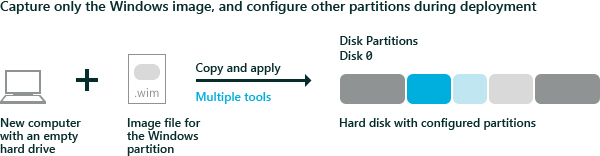
Capture the image
-
If you've booted into Windows, generalize the epitome so that it tin can exist deployed to other devices. For more than information, run across Sysprep (Generalize) a Windows installation.
-
Boot the device using Windows PE.
-
Optional Optimize the paradigm to reduce the time it takes your device to boot afterwards you apply the image. Optimizing an image especially helps when you're building an image that you'll be deploying to many machines, like in a build-to-stock scenario.
DISM /image:C:\ /optimize-image /boot -
Capture the Windows segmentation. For case:
Dism /Capture-Epitome /ImageFile:"D:\Images\Fabrikam.wim" /CaptureDir:C:\ /Name:FabrikamWhere D: is a USB wink drive or other file storage location.
Apply the image
-
Boot the device using Windows PE.
-
Wipe the difficult drive and set up new hard disk partitions using a script. Use CreatePartitions-UEFI.txt (or CreatePartitions-BIOS.txt for older, legacy BIOS devices).
diskpart /s CreatePartitions-UEFI.txt -
Apply the images using a script.
D:\ApplyImage.bat D:\Images\Fabrikam.wim
Sample script
Below is an unproblematic sample script that applies an image to a disk that's been partitioned using one of the hard disk partitioning scripts from pace 2.
rem == ApplyImage.bat == rem == These commands deploy a specified Windows rem image file to the Windows partitioning, and configure rem the arrangement division. rem Usage: ApplyImage WimFileName rem Example: ApplyImage Due east:\Images\ThinImage.wim == rem == Set high-functioning power scheme to speed deployment == phone call powercfg /southward 8c5e7fda-e8bf-4a96-9a85-a6e23a8c635c rem == Utilise the paradigm to the Windows segmentation == dism /Apply-Image /ImageFile:%ane /Index:1 /ApplyDir:W:\ rem == Re-create boot files to the Organization partition == Westward:\Windows\System32\bcdboot West:\Windows /s S: :rem == Copy the Windows RE epitome to the :rem Windows RE Tools partition == doc R:\Recovery\WindowsRE xcopy /h W:\Windows\System32\Recovery\Winre.wim R:\Recovery\WindowsRE\ :rem == Register the location of the recovery tools == W:\Windows\System32\Reagentc /Setreimage /Path R:\Recovery\WindowsRE /Target W:\Windows :rem == Verify the configuration status of the images. == West:\Windows\System32\Reagentc /Info /Target W:\Windows Deploy Windows using Total Flash Update (FFU)
Capture and Employ Windows, System, and Recovery Partitions
Configure UEFI/GPT-Based Hard Drive Partitions
Configure BIOS/MBR-Based Hard Drive Partitions
BCDboot Control-Line Options
REAgentC Control-Line Options
Source: https://docs.microsoft.com/en-us/windows-hardware/manufacture/desktop/capture-and-apply-windows-using-a-single-wim
Posted by: smithcappirms.blogspot.com
0 Response to "How To Create Wim Image Windows 10"
Post a Comment