

How To Setup Network On Windows 8
The Network and Sharing Center in Windows seven, 8 and 10 is 1 of the more important and useful Control Panel apps that lets y'all run into information nearly your network and lets you make changes that can affect how you access resources on the network.
Unfortunately, almost people never mess effectually with network settings considering they don't sympathize what everything means and are afraid to mess something up. However, once you understand the settings, yous tin fix issues on your ain, increment your privacy, and quickly setup file and printer sharing betwixt multiple computers.
In this commodity, I'll walk you through the different aspects of the Network and Sharing Middle and bear witness you certain features yous tin use on a regular basis to make yourself more productive.
Opening Network & Sharing Centre
The first step is to open the Network and Sharing Center. The quickest way to get to it is by clicking on Offset and typing in network and. This will instantly bring up the app in the list.
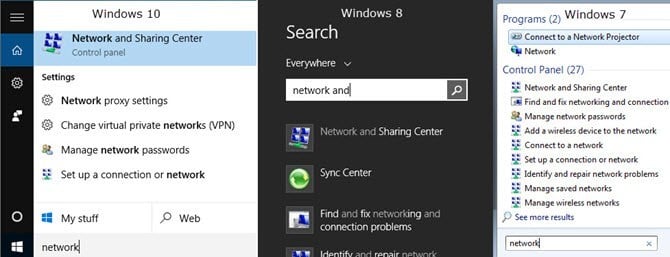
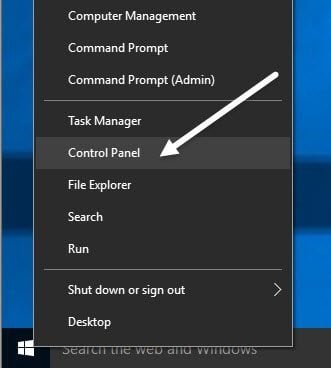
In all versions of Windows, the app is located in the Command Panel. In Windows 7, just click on First and the Control Panel is listed on the right side of the Commencement Bill of fare. In Windows eight.ane and Windows 10, simply right-click on the Start Menu and cull Control Panel from the listing.
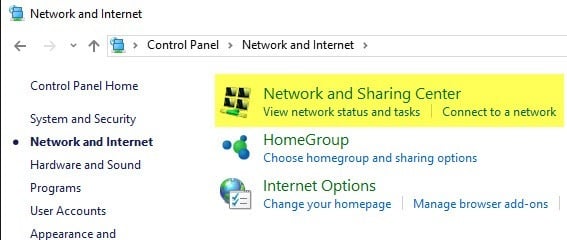
In the Control Panel, you lot can click on the Network and Net category and then click on Network and Sharing Center. If yous are in icon view, just click directly on Network and Sharing Center.
Private or Public Network
The first thing you'll see when you open the Network and Sharing Center is your current connection to the network and to the Net. Windows 7 has a little fleck more than information and as well a couple of more than options.
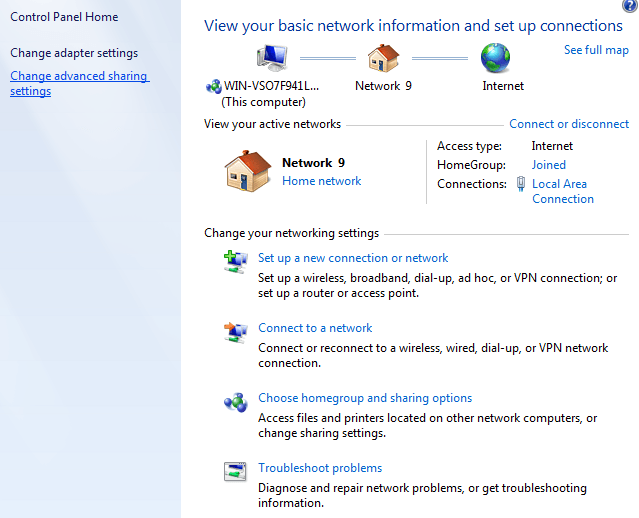
In Windows eight and Windows 10, they cleaned up the interface by getting rid of a couple of items and combining other items.
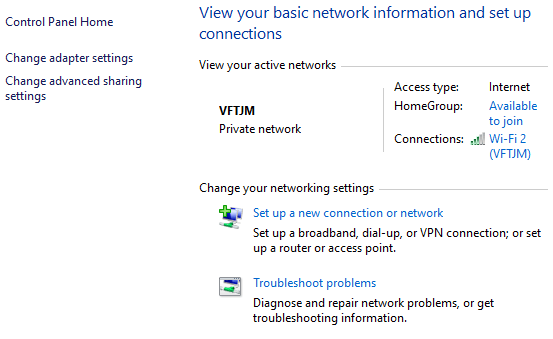
At the top, you'll see the active network or networks, the network blazon, the type of access, HomeGroup info and the connection info. The first thing to understand about this info is the network type, which is listed straight below the name of the network.
In the to a higher place examples, one has Home network listed and the other has Private network listed. This is very important considering when you are connected to a private or dwelling network, there are a lot of sharing settings that are ready by default to be trusting. This means others can observe your computer on the network, possibly access shared folders, stream media from your computer, etc.
Windows will usually try to effigy this out for y'all automatically and so that when you lot connect to a public WiFi network, information technology will use thePublic profile and not the private one. Sometimes, Windows will ask you lot if you desire to enable sharing or detect devices once you connect to a network and if you say yeah, information technology will make the network private. If yous choose no, it will make the network public.
Y'all can also manually change the network blazon to Public or Individual depending on what kind of privacy you want. This can exist useful, for example, if you are visiting someone and you lot want to make sure no one can access any data on your computer while you are continued to their network. Modify the network type to Public and no one will be able to notice your estimator on the network.
You can read my post on how to switch between public and private for the currently continued network. So what exactly does switching do? Well, you can see all of the dissimilar sharing settings when you click on the Change advanced sharing settings link, which I explicate in detail in the side by side department below.
To the right of the network name and network type, you'll meet HomeGroup and Connections. Next to HomeGroup, you'll see a link that says Available to bring together or Gear up to create depending on whether a HomeGroup already exists on the network or not. A HomeGroup allows you to easily share files, printers and more than betwixt computers. I talk more about it in the Advanced Sharing Settings section below.
Next to Connections, y'all can click on the name of the WiFi or Ethernet network to bring upward the status info dialog for the current connection. Here yous can see how long you have been connected, the betoken quality for WiFi networks, the network speed, etc. Yous can likewise disable the connection and diagnose the connectedness if there is a trouble.
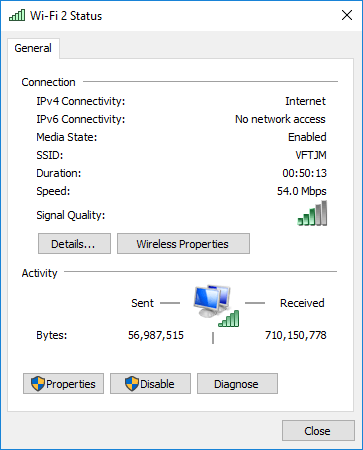
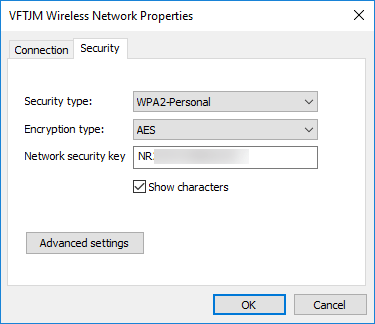
For WiFi networks, this screen is useful because you lot tin click on Wireless Properties and then click on the Security tab and view the WiFi password. This is really useful if you have forgotten the WiFi countersign, merely yet have a calculator that is connected to the network.
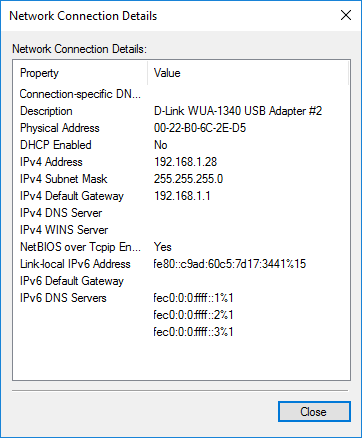
Lastly, if yous click on Details, you tin get more info about the current network like the Default Gateway (router IP address), MAC address, and reckoner IP address.
Avant-garde Sharing Settings
The avant-garde sharing settings dialog is main identify for managing how your computer communicates with the rest of the network. In Windows 7, yous have two profiles: Home or Work and Public. But 1 profile tin be active at a time. All the settings are the same and repeated nether each profile.
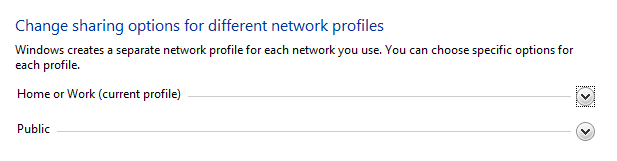
In Windows 8 and ten, you take three profiles: Individual, Guest or Public and All Networks. Basically, information technology's the same settings as in Windows 7, only but split up more than logically. Permit's get through the various settings:
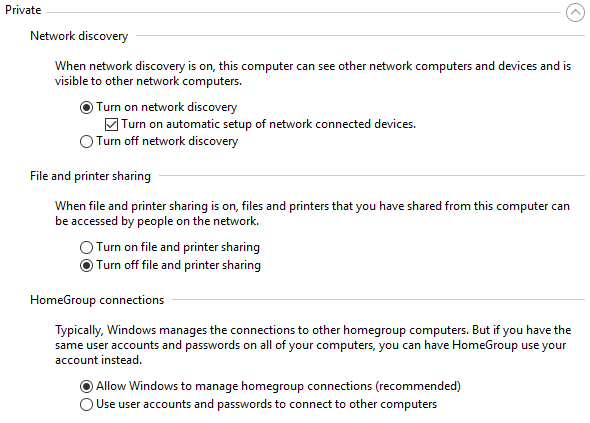
Network Discovery – This setting is turned on for individual networks past default and it means that your computer can be seen past other computers and vice versa. What this ways in practice is that when yous open Windows Explorer, you might see the proper noun of some other estimator connected to your network under Network Locations.
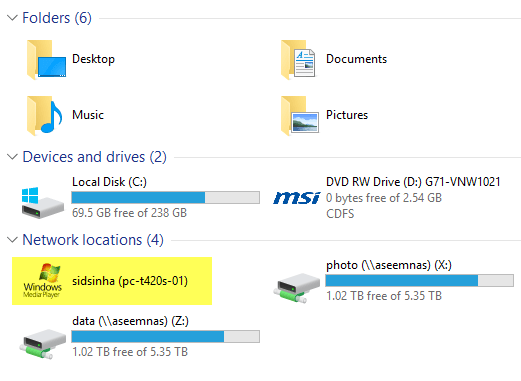
File and Printer Sharing – This setting will allow others to admission shared folders and printers on your computer. I ever plow this to Off even on individual networks unless I need to use it in a specific situation. There are then many times when guests come over to my house, connect to the network and and then could mayhap browse my organisation. Simply shared folders tin be viewed, but you'd exist surprised how folders tin become shared without your knowledge.
HomeGroup connections – If you actually exercise need to share files and folders, you should just setup a HomeGroup, which is more secure and a lot easier to configure. If you exercise encounter trouble, just read my HomeGroup troubleshooting guide.
At present expand out All Networks if you lot are using Windows 8 or Windows ten. There are a couple of more settings here.
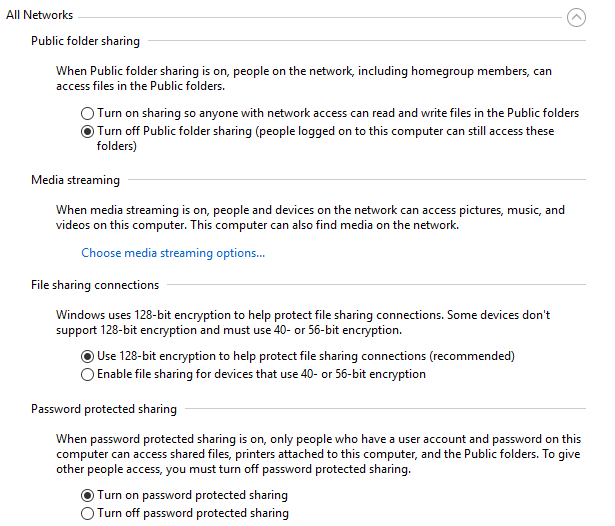
Public Binder Sharing – I recommend turning this off unless you specifically need to share data with another figurer. The reason is that it'south very easy to accidentally save files into these publicly shared folders without realizing information technology, which will so be accessible past anyone on the network. A very useful feature when you need it, but a big privacy risk otherwise.
Media Streaming – This is another option y'all should proceed disabled until you need to use information technology. This basically turns your figurer into a DLNA server and then that you can stream music, movies and pictures to other devices on the network like an Xbox I, etc. When enabled, it opens up quite a few ports in your firewall also.
File Sharing Connections – This should e'er be set to Use 128-bit encryption unless y'all need to share files with Windows 95, Windows 98 or Windows 2000 computers.
Password Protected Sharing – I highly recommend turning on password protected sharing considering it volition force users to enter a username and password for an account on your computer in order to access any data.
Setup New Network & Troubleshoot Problems
The next function I want to talk about is the department under Change your networking settings. In Windows x, yous can either setup a new connection or troubleshoot problems.
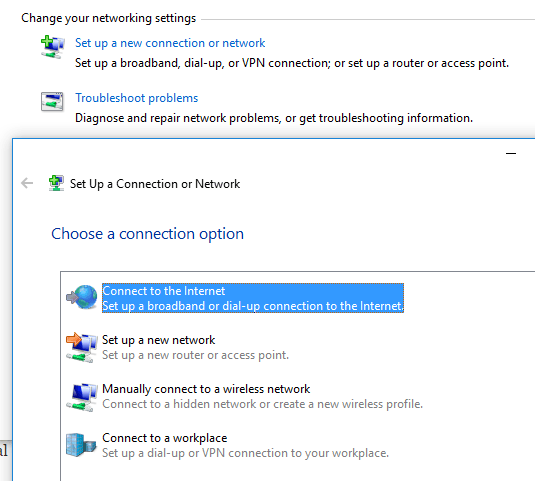
For setting up a new connexion, y'all only accept four options in Windows 8/10: Connect to the Internet, Setup a new network, manually connect to a WiFi network or connexion to a VPN. Note that creating an ad-hoc network is no longer possible in Windows 10.
If y'all click on Troubleshoot problems, y'all'll get a list of troubleshooting links for the Internet, network adapter, HomeGroup, Shared Binder, Printers, etc.
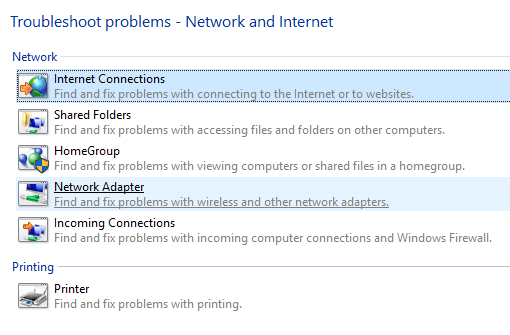
These are not just troubleshooting guides, they are actual programs that run and fix issues with various networking related services. I have institute the Internet Connections and Network Adapter troubleshooting fixes to exist the most useful.
Change Adapter Settings
Lastly, allow's talk almost the Change adapter settings link on the left-paw side. You probably won't apply this also oft, merely it does come up in handy when troubleshooting network problems.
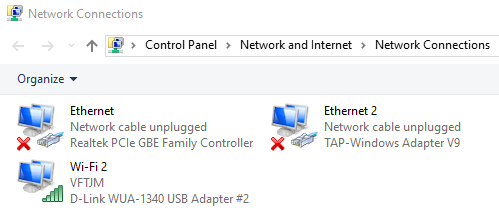
Hither you lot will come across a listing of all the network adapters on your computer. If you have an Ethernet port and WiFi card, yous'll encounter both items listed. Yous might besides run into other network adapters, but they are unremarkably always virtual, significant they are created by a software awarding like a VPN client or virtual machine programme.
If you're having connection problems, you can simply right-click on the adapter and choose Diagnose. This volition commonly gear up any trouble with a misconfigured network adapter. If you right-click and cull Properties, you can configure your computer to use a static IP address rather than obtaining one from a DHCP server.
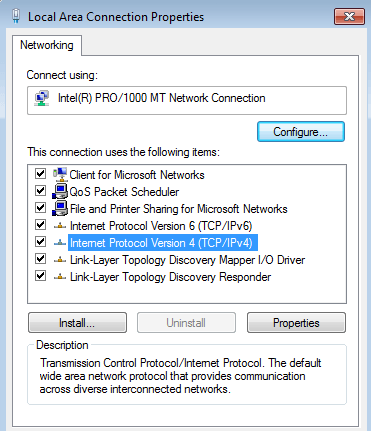
Every bit mentioned, this is not something you'll need to do often, just it'due south skilful to know for troubleshooting purposes. For the technically savvy, there are a lot of other advanced settings yous can modify here, but this guide is meant for newbies.
Hopefully, this article will help you navigate the Network & Sharing Center settings without feeling overwhelmed. It's the easiest way to fix network problems and to make your computer more secure past disabling a lot of the automatic sharing enabled by default. If you take any questions, post a comment. Relish!
Do not share my Personal Information.
Source: https://www.online-tech-tips.com/windows-7/network-and-sharing-center-overview/
Posted by: smithcappirms.blogspot.com
0 Response to "How To Setup Network On Windows 8"
Post a Comment